.svg)
When complications occur outside the hospital, ambulance officers and paramedics are on the front line, often facing situations that classroom training and textbooks cannot fully prepare them for.
NEONATE-in-VR, a new virtual reality program, was developed to bridge this gap, giving paramedics virtual experience and building the confidence they need to manage real-life births.
The idea was born from Edith Cowan University PhD candidate Michella Hill, with the innovative solution earning the Western Australian major recognition - a Merit at the 2025 INCITE Awards and another Merit at the 2025 Australian iAwards.
Michella's success is now taking her from Western Australia to Taiwan in early December, where she will represent Australia at the Asia-Pacific ICT Alliance (APICTA) Awards.
“Honestly, I thought I had Buckley’s chance of receiving a merit award at the INCITE Awards, so I didn’t really believe it. It was also amazing and quite stunning to receive the iAwards,” Michella said.
NEONATE-in-VR began when Michella started her PhD journey. She realised that obstetrics had always been an area of personal interest.
But she also noticed a gap: many paramedics lacked confidence in managing obstetric emergencies, simply because such cases make up less than 1% of their workload in emergency services.
“I wanted to dust that topic off, and we were really fortunate,” Michella said, reflecting on how this idea sparked the birth of NEONATE.
With $50,000 from a Western Australian Department of Health CSTAN grant, Michella and her team focused on what was realistically achievable within that budget. They chose a specific, manageable part of obstetrics for simulation training, as the topic is often considered “dusty” by paramedics.
.jpg)
Michella Hill (front right) with her team from Edith Cowan University at the 2025 INCITE Awards. Photo: Cohesion Co/WAITTA
For women in labour, both volunteer officers and paramedics provide limited supportive care, Michella explains.
Volunteers cannot insert a cannula to provide fluids and can only offer oral pain relief and anti-nausea medication. Many pre-hospital medications cannot be administered during active labour, as this may affect the baby’s breathing.
“Volunteer training often focuses on textbook births with only a brief overview of complications, so volunteers don’t recognise critical red flags,” Michella added.
Future additions to NEONATE-in-VR will include intubation, intraosseous medication, or, for places without medical equipment, using little puffs of mouth-to-mouth resuscitation instead of a Bag Valve Mask, as well as birthing scenarios such as normal birth, breech birth, and shoulder dystocia.
Michella said that NEONATE-in-VR's 30 to 40 minute virtual reality (VR) training begins with an introductory scenario that guides users through identifying red flags in the first moments of a baby’s life while providing key clinical information.
It also helps users, particularly mature clinicians unfamiliar with VR, to learn to use the controllers to operate a Bag Value Mask and assist a newborn’s breathing.
The second scenario, known as the 'Do It Yourself (DIY)' version, features a cheat sheet screen to track progress.
Users can access tips or consult the Australian Resuscitation Council flow chart at any time, Michella said. In this scenario, participants manage a baby in respiratory distress, aiming to restore their health.
To increase complexity, the VR training solution continues with the baby deteriorating into cardiac arrest, requiring CPR. It concludes there, with participants expected to follow their own ambulance service’s clinical practice guidelines for the next steps in clinical management.
Overall, the program features three key scenarios: a healthy baby, a baby in respiratory distress, and a baby that requires CPR. The VR
training not only strengthens clinical confidence and knowledge but also builds confidence in using virtual reality as a practical tool for
developing essential skills in pre-hospital care.
All participants in NEONATE-in-VR training to date have provided
overwhelmingly positive feedback, Michella said.
The VR program can easily be accessed anytime and anywhere using standard VR equipment.
“A standard gaming computer with two controllers and a headset, is sufficient to run the program,” Michella said
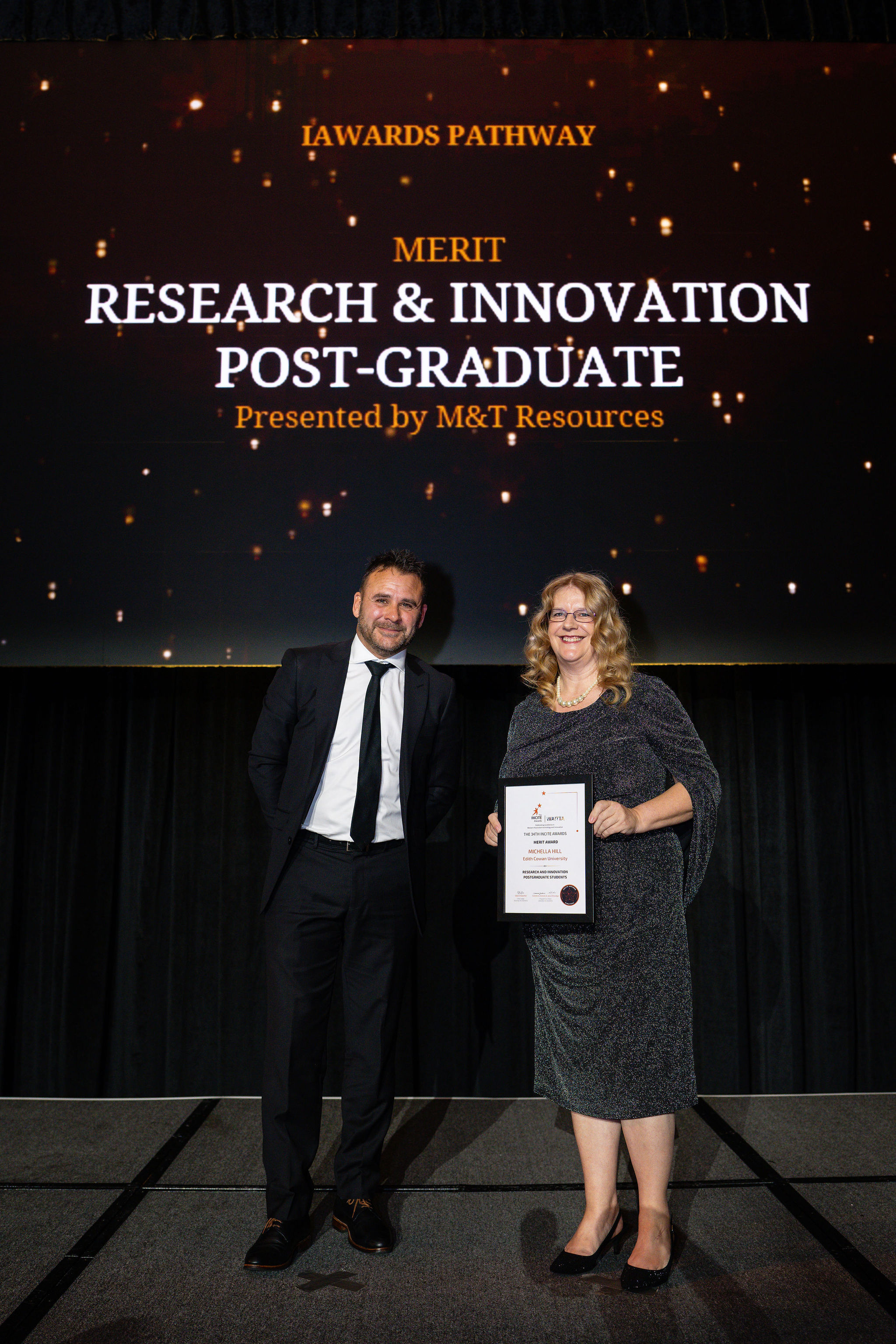
Michella Hill receives Merit at the 34th INCITE Awards for NEONATE-in-VR from M&T Resources' Kevin Howell. Michella's Merit has taken her from the WA awards to the national iAwards and now the international Asia-Pacific ICT Alliance Awards in Taiwain. Photo: Cohesion Co/WAITTA
Classroom simulation is not realistic, volunteers and paramedics reported via Michella's research.
A healthy baby’s heart rate is typically 100 beats per minute or above, but distinguishing whether it is over or under that threshold can be difficult.
This challenge is hard to replicate with classroom simulations using plastic mannequins, highlighting the effectiveness of VR, Michella said.
Unlike mannequins, which provide no visual cues and require facilitators to answer questions about skin colour or heart rate, VR allows users to make independent clinical decisions, she said. Participants can assess the baby’s colour, listen to the heartbeat, and practice real clinical judgment.
Ambulance officers and experienced paramedics need to quickly assess whether a newborn is breathing effectively and whether their heart rate is sufficient, or if Bag Valve Mask support is required.
“From the scoping review I conducted, it became clear that more deaths occur in the pre-hospital environment than in hospitals, which is not unexpected, especially with premature babies,” Michella highlighted.
About one in 10 babies require assistance with breathing, yet in the pre-hospital setting support is often not provided before arrival at the hospital according to the scoping review data.
This can result in babies arriving in distress, sometimes hypothermic, which increases the risk of complications such as seizures and, in severe cases, death, Michella said.
The VR solution addresses these risks by training participants to monitor breathing and body temperature, ensuring early interventions can be made in real-life pre-hospital care.
Michella said, from here, sky is the limit on further iterating the NEONATE-in-VR training solution.
Future additions to NEONATE-in-VR will include intubation, intraosseous medication, or for the places without medical equipment, using little puffs of mouth-to-mouth resuscitation instead of a Bag Valve Mask, as well as birthing scenarios such as normal birth, breech birth, and shoulder dystocia.
Connect with Michella Hill on LinkedIn, and find out more on the Edith Cowan University website.



INCITE Awards
INCITE Awards
INCITE Awards
.png)