.svg)
“Innovation isn’t about reacting to failure — it’s about preventing it altogether.” — Professor Ahmed Abu-Siada
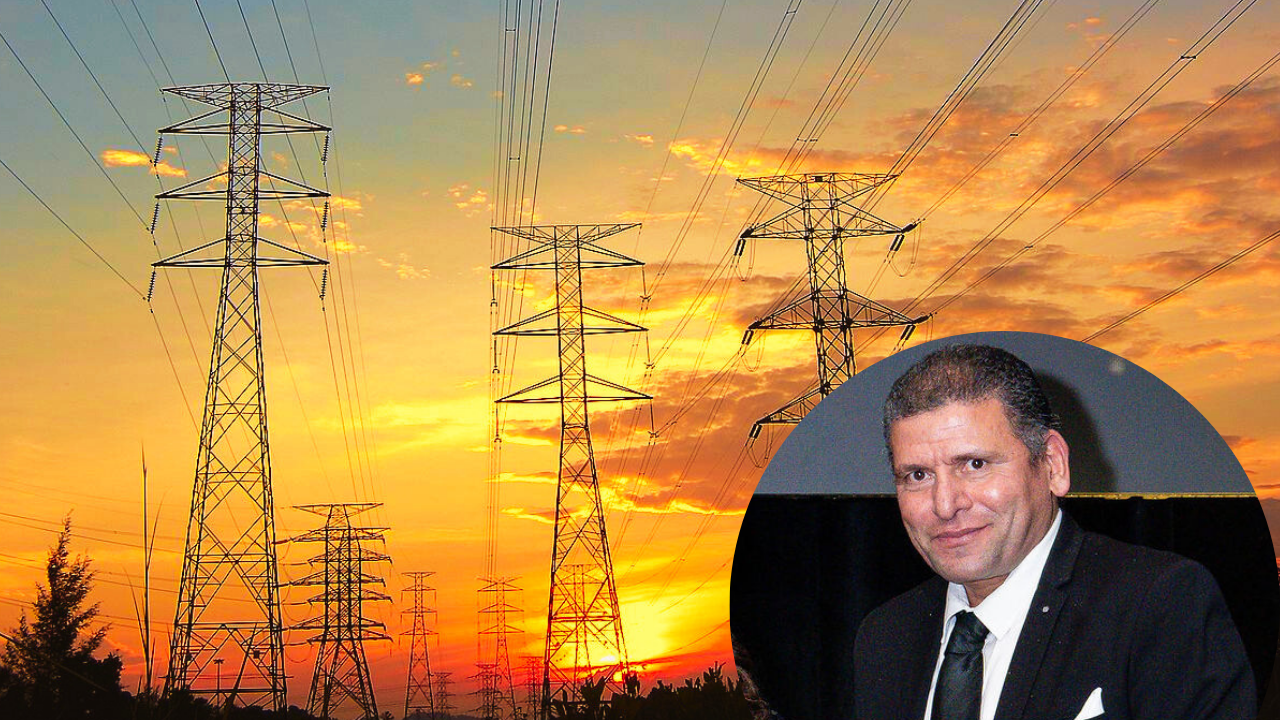
Western Australia's Professor Ahmed Abu-Siada (inset) has developed an internationally recognised technology solution to prevent bushfires triggered by rural powerline faults.
When large electrical power systems fail, the consequences can be severe. Widespread blackouts, economic disruption, environmental damage, and bushfires are just some of the outcomes that can follow faults in high-voltage infrastructure.
These failures rarely affect only one location or one industry. Instead, they ripple across communities, transport networks, businesses, and ecosystems.
What makes these incidents particularly challenging is that they rarely begin with dramatic warning signs. In many cases, the damage starts quietly — with small, undetected faults developing over time, long before failure becomes visible.
Read more: Western Australia's innovative tech talent shines at 2025 iAwards
For Professor Ahmed Abu-Siada of Western Australia, the path from research to real-world impact has been shaped by what happens when power systems fail.
An internationally recognised researcher at Curtin University, Ahmed saw firsthand how small, undetected electrical issues can escalate into devastating consequences. He cites the 2009 Black Saturday bushfires in Victoria as one of the earliest catalysts for his work; the Victorian bushfires were sparked by a power line failure, contributing to one of the country’s deadliest natural disasters.
Internationally, a transformer fire at a substation near London’s Heathrow airport caused a major power outage that grounded thousands of flights and disrupted global travel. The incident highlighted how a single fault in critical electrical infrastructure can have far-reaching consequences beyond the immediate area.
A decade after Victoria, similar circumstances led to the 2019 Black Summer bushfires across Australia.
Together, these events became a turning point for Professor Abu-Siada, driving his determination to develop a technology capable of identifying early warning signs in power infrastructure before they end up into catastrophic outcomes.
Professor Abu-Siada is the mind behind ViON. A breakthrough power safety technology that is positioning Western Australia on the global innovation stage.
At its core, VION is designed to predict faults in high-voltage infrastructure before they escalate into serious incidents.
“These failures don’t happen suddenly,” he explains. “They develop over time. I wanted to build a system that provides early warning signs and prevents disasters before they occur.”
To understand ViON, imagine the power network as a system that has a normal rhythm.
Every asset — from power lines to transformers — behaves in predictable ways when everything is operating as it should. ViON learns those normal patterns and monitors them over time.
When something begins to change — due to wear, weather or external stress — those patterns start to shift. Often, these early signs appear long before a fault is visible or causes disruption.
What makes this challenging, Professor Abu-Siada explains, is that early-stage faults are rarely visible. A transformer or power line can look fine from the outside, even as small electrical changes begin to build up inside.
ViON detects those subtle changes early, helping network operators identify emerging issues before they turn into failures.
“Every asset has its own signature,” Professor Abu-Siada says. “When that signature starts to change, it tells us that something abnormal is happening.”
Instead of waiting for visible damage or relying on infrequent inspections, ViON continuously analyses voltage and current measurements to create a unique digital fingerprint for each high-voltage asset.
It learns what “normal” looks like for each individual transformer or power line and looks for subtle changes.
When ViON detects that the behaviour no longer matches an asset’s normal pattern, it flags an early warning and alerts the maintenance team of abnormal changes.
Watch: Curtin University's Professor Ahmed Abu-Siada explains ViON / YouTube
This allows utilities organisations to investigate and take action early — before a minor issue turns into a serious incident, particularly in environments prone to extreme weather and bushfire risk.
Yet many power monitoring systems remain reactive, Ahmed explains. Traditional approaches rely heavily on visual inspections, periodic testing, or additional sensors.
However, ViON can operate 24/7, monitoring large electricity networks from a central location, without the need for on-site intervention unless needed.
Professor Abu-Siada says the software not only helps protect communities and the environment, but also reduces the time and cost involved in frequent visual checkups, emergency repairs, asset replacement, and large-scale outages.
While ViON may appear simple in concept, it is the result of more than a decade of research into power systems and high-voltage asset management.
Throughout his academic career, Professor Abu-Siada has focused on understanding how and why power infrastructure fails — and how those failures can be prevented.
Working closely with utilities and infrastructure operators, he saw firsthand how existing systems struggled to provide early warning. He recognised that a predictive approach — one capable of detecting subtle changes long before visible damage occurred — could significantly improve safety and reliability.
“I wanted to build something that utilities could trust,” he says. “Something that works with the data they already have, rather than adding more complexity.”
Curtin University’s innovation and commercialisation programs played a key role in translating laboratory research into a real-world solution. Participation in CSIRO-led business modelling workshops further clarified how ViON could be deployed at scale, he shares.
The technology has since secured two patents — an international patent covering power transformers and an Australian patent for overhead transmission lines — marking significant milestones in its journey from research to application.
Collaboration with industry partners such as Western Power and ABB has been vital. These partnerships enabled ViON to be tested in live environments, reinforcing confidence in its practicality and reliability.
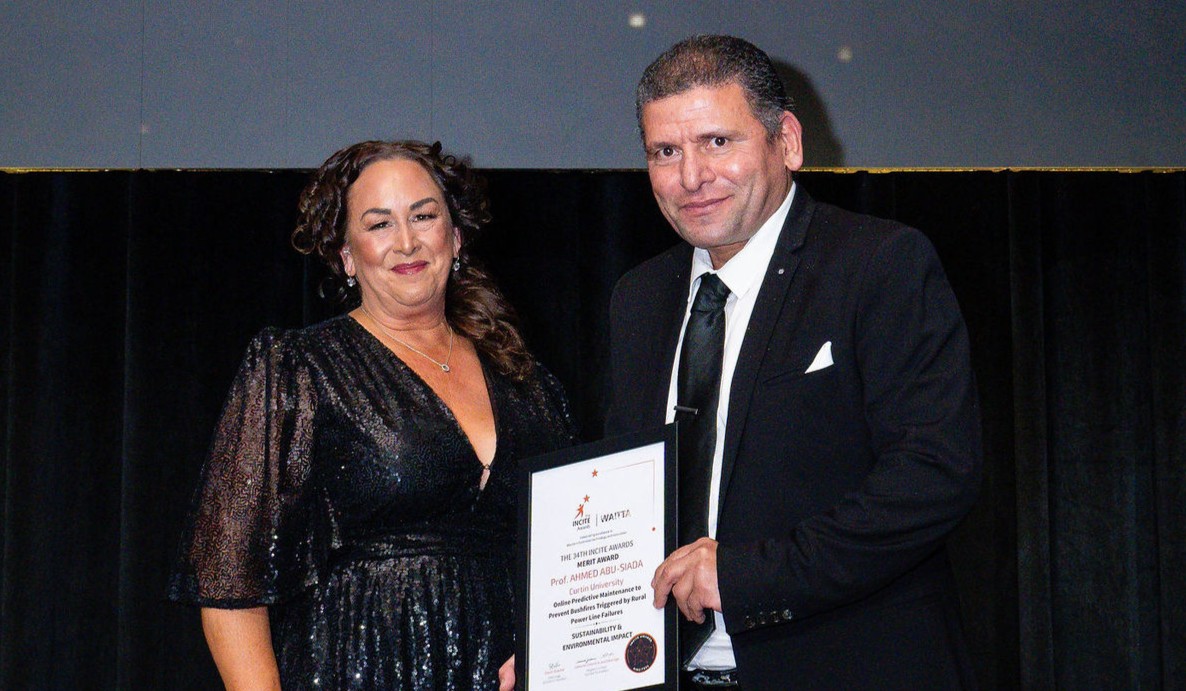
Professor Ahmed Abu-Siada received a Merit in Sustainability & Environmental Impact at the 34th INCITE Awards. He's pictured
here at the ceremony with award sponsor Kinetic IT's Michelle Major-Goldsmith. Photo: Cohesion Co
Read more: How WA's NEONATE in VR is equipping paramedics to save lives beyond the hospital
ViON was a Merit recipient at the 34th INCITE Awards in Sustainability & Environmental Impact, taking Professor Abu-Siada to the national iAwards, and ultimately to the Asia-Pacific ICT Alliance (APICTA) Awards.
Western Australia was represented by three nominees at APICTA: Professor Abu-Siada for preventative electrical outage solution ViON, Michella Hill of Edith Cowan University for NEONATE-in-VR – a solution helping upskill at scale international health teams to deliver babies, and Norwood Systems for Open Span™ Call Protect, an AI telecommunications solution.
Professor Abu-Siada first entered the INCITE Awards after encouragement from Curtin University colleagues — and was surprised by the breadth of the program.
“I initially thought INCITE was just for students,” he says. “I didn’t realise how open it was to industry and research innovation.”
After a Merit at the INCITE Awards, and a Merit at the national iAwards, ViON progressed to the APICTA Awards as a finalist representing Western Australia.
Participating in APICTA proved especially meaningful, Ahmed explains.
“What stood out most was seeing students — even high school students — presenting brilliant, simple ideas,” he reflects. “They are the generation that will shape the future.”
Having navigated the journey from concept to global recognition, Professor Abu-Siada encourages emerging innovators to focus on feasibility as much as creativity.
“Brilliant ideas are important but they also need to be cost-effective, safe, and practical to implement.”
Ahmed says that programs such as INCITE, iAwards, and APICTA play a vital role in bridging research and industry by providing visibility, credibility, and global exposure.
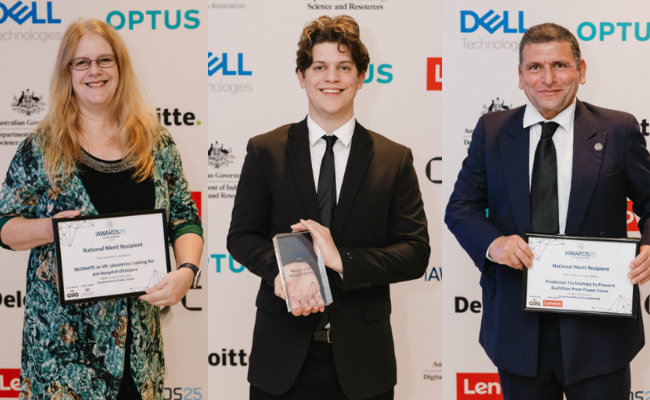
Professor Ahmed Abu-Siada (pictured on the far right) along with Michella Hill and Cody Dalliston were some of the six Western Australian technology projects to secure a win or merit at the 2025 Australian iAwards.
As demand grows for safer, more resilient energy infrastructure, technologies like ViON demonstrate how Western Australian research can deliver solutions of global impact.
By combining deep technical expertise with practical design, Professor Abu-Siada and ViON can help reshape how power networks are monitored — shifting the industry toward prevention rather than reaction. Professor Abu-Siada says he hopes to contribute to strengthening Australia’s position at the forefront of predictive power safety innovation — proving that world-class solutions to global challenges can be built right here in Western Australia.
The next phase for ViON focuses on expanding real-world trials, particularly on overhead transmission lines, and moving toward full commercial deployment through software licensing to utilities and regulators.
“Once people see real-world results, confidence will grow. The beauty of this technology is that utilities don’t risk anything — they simply give us access to data they already collect.”
ViON stands as a powerful example of how innovation developed in Western Australia can help prevent disasters, protect communities, and strengthen critical infrastructure worldwide.
By combining deep technical expertise with real-world applicability, Professor Ahmed’s work exemplifies the spirit of the INCITE Awards: innovation that doesn’t just push boundaries, but genuinely protects lives and communities.
Get in touch with Professor Ahmed Abu-Siada via LinkedIn.



INCITE Awards
INCITE Awards
INCITE Awards

.png)